My Food Journey Part 3: Lessons from the Farm
Before I ever worked on a farm, I met farming through a restaurant.
I was working in a vegan restaurant (Envie), when the restaurant built a relationship with Abundant Acres Farm to grow crops specifically for us. We used a lot of vegetables… especially kale. One of our most popular dishes was a kale Caesar salad, and we probably sold fifty or more a day. That kind of demand meant we needed a farmer we trusted.
One day, when the restaurant was closed, the whole staff went out to the farm. That was the first time I really visited a farm. Not as a tourist, not for a cute afternoon, but as someone stepping into the place where the food actually begins.
At the time, I didn’t know how important that day would become.
Later that year, after quitting my job at Envie and going through a bit of a hard time personally, I reached back out to the farm and ended up working there. For 6 months, I spent three days a week on the farm, and selling veggies for them at the Saturday Farmers Market.
The first and most obvious lesson: farming is hard. Early mornings. Long days. Dirt under my nails. The work was physically, relentlessly, uncompromisingly hard.
You’re crouched over for hours. Bent at the waist. Kneeling in the dirt. Rocks slipping into your boots. Repetitive motions that don’t feel like much at first but add up fast. You wake up before sunrise every day, gather as a team for coffee and breakfast, go over the plan, and then you’re in the field as the light comes up. It’s demanding in a way that’s difficult to explain unless you’ve done it.
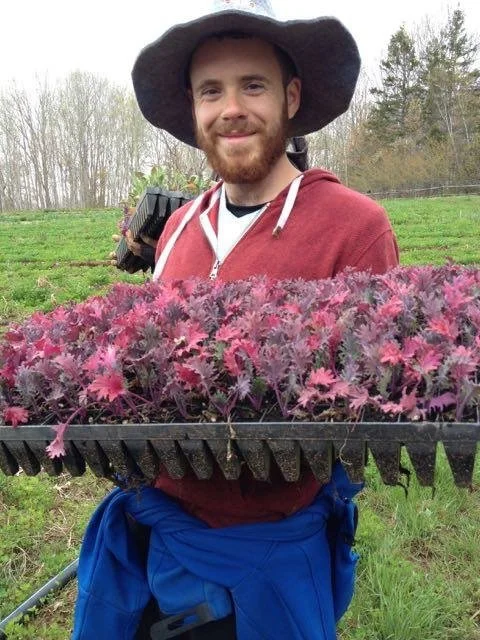
My first time on a farm, planting thousands of kale seedlings
One memory in particular has stayed with me.
We were harvesting tomatillos for a client who needed a large batch for salsa verde. There was a deadline. We were already behind. And then, out of nowhere, a hailstorm rolled in. It was late summer, maybe early fall. The mosquitoes were brutal that day. Especially in that field, which sat near a swampy area. High moisture. Perfect conditions for getting eaten alive.
And then the sky opened.
Big hail. Not the gentle kind. Marble-sized. Pelting down hard enough that it hurt. Ice collecting so fast that our boots were sloshing through it, ankle-deep in places.
And we kept going.
There was no option to stop. The client still needed their order. The plants wouldn’t harvest themselves. So we worked. Being stung by mosquitoes, getting hammered by hail, soaked, cold, exhausted. Just trying to get the job done. Standing there in that moment, I remember thinking:
Wow. This work is so undervalued.
So underpaid. So taken for granted.
People talk about food like it appears. Like it’s just there. But farming is craft. It’s endurance. It’s skill built through repetition and pain and patience. It’s weather risk and timing and physical labour stacked on top of each other.
That experience gave me a level of respect for farmers that never left. From there, my relationship to farming kept evolving.
I helped start a small farmers market on campus with my friend Sarah, selling produce directly to students. I apprenticed on a homestead, learning about seed saving, food preservation, and growing for community rather than scale. And later, through my research work, I spent time alongside migrant farm workers, seeing firsthand how much skill, care, and experience goes into agricultural labour. And just how invisible that labour often is.
Across all of those experiences, the lesson stayed consistent:
Food systems are built on bodies.
On people who wake up early. Who work in uncomfortable conditions. Who carry knowledge in their hands that doesn’t show up on price tags.
The farm taught me humility. It taught me patience. And it taught me that if we want to talk seriously about food, about sustainability, access, justice, or resilience, we have to start by respecting the people who grow it.
Everything else builds from there.
This writing is always free to read.
If it nourished you in any way, you can buy me a coffee below and help fuel what comes next ☕️
